That’s right! It’s time for everyone’s favorite: the root canal. When I began shadowing dentists, I thought the root canal was going to be the procedure that finally made me uncomfortable enough to question my career choice. On the contrary, root canals are probably my favorite procedure to watch. To be absolutely honest, root canals and extractions share a lot of similarities. Nobody wants a root canal. They get a bad rap for being painful. Similarly to the extraction, I really can’t offer much in the way of consolation. However, learning about the procedure and its importance may serve to ease some of your anxiety if you have a root canal coming up.
Digging Deeper: What is a Root Canal?
Another thing that extractions and root canals have in common is that they are usually saved as last-ditch efforts to save a tooth. In most cases, if a root canal is to be performed, an extraction has at least been considered. However, root canals are considered preferable, as they maintain much more original tooth structure and don’t leave a gap in your teeth. Gaps in teeth allow things to move around such that additional problems may arise in the future. Although more expensive, root canals are often the preferred course of action for this reason.
“Root Canal” is only the most common name. The procedure is also called “pulpotomy” or “endo” in office shorthand. Dentists who choose to continue their education and specialize in performing root canals are called endodontists, which is where the office shorthand originates. However, my favorite of its names is pulpotomy, as it describes the procedure right in the name (-otomy refers to cutting or removal in Latin, so “pulp removal”). If you need a root canal, your dentist, or endodontist if your case is particularly tricky, will do just that; they will open the tooth and remove the pulp from the crown and root.
Why Me: Why You Need a Root Canal
As we’ve already discussed, root canals are not the first line of defense for dental care. In fact, they are among the last measures possible before extraction. There are a number of reasons a root canal may be necessary, but in short, the pulp of your tooth has become infected or damaged in some way beyond what can be fixed with medication. The most common causes are an untreated cavity which has reached the pulp, an abscess beneath the root, or some sort of dental trauma. It just so happens that these are listed from the most to the least preventable.
Obviously, you can prevent an untreated cavity by (wait for it) treating your cavities! All joking aside, proper dental hygiene and regular cleanings and checkups will prevent most, if not all, of this kind of root canal. If left untreated, the acids from the plaque within a cavity will continue to degrade the enamel and dentin until it reaches the pulp, resulting in excruciating pain due to the extensive network of nerves within it. I’ve said it a million times, but believe me. You definitely want to keep up with the brushing and flossing!
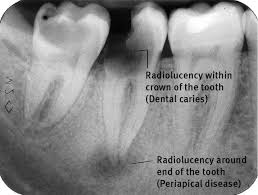
Second, and perhaps most common, is the periapical abscess, shown in the x-ray above. Time for more Latin! “Peri-” means “around,” “apical” refers to the apex of the tooth root, and an abscess is a wonderful little pocket filled with a concoction of bacteria, waste, and dead cells. It is somewhat sufficient to think of a periapical abscess as a pimple at the base of your tooth’s root, except it’s in your bone instead of your skin. This apical acne is much more serious, however. Benzoyl peroxide won’t be getting you out of this one in time for senior prom, I’m afraid. As you can see above, these abscesses show up as dark, or radiolucent, meaning they are degrading bone tissue. While it is possible to diminish a small abscess with antibiotics, a pulpotomy is the most effective way of clearing out this infection. Abscess is most common in patients who clench their teeth, or in teeth which have already had some sort of work done.
Finally, dental trauma can also be cause for a pulpotomy. I once saw a man who had gotten headbutted straight in the chin during a local basketball tournament over a decade earlier. His teeth luckily did not all fall out, so he assumed all was well. He now has root canals in all of his mandibular incisors in his mid twenties. Essentially, the other kid’s head acted as the grim reaper himself, for once the collision happened, the teeth were considered “dead.” One way or another, the nerves and blood vessels within his teeth had been cut off, essentially killing the tissue. Dead tissue is perhaps bacteria’s favorite food, so a pulpotomy is often performed to prevent an abscess.
Route to the Root: The Procedure
Full disclosure: pulpotomy is a very complex procedure with a number of different avenues for performance. I will do my best to describe most accurately the common steps I’ve seen, but understand that the exact actions your dentist or endodontist may take could vary. As with any medical procedure, the first step in treatment is detection. Untreated cavities will likely not be so hard to detect. If inserting an implement into a cavity is able to proceed far enough and ends in a very painful “spike,” it’s likely that a pulpotomy is necessary. Abscesses can be seen in an x-ray, as shown. Additionally, the dentist may massage the gums at the base of the tooth or lightly tap on the crown to test for sensitivity. On the contrary, a traumatized tooth will be tested, either by tapping or extreme cold, to test for a lack of sensitivity, which indicates tooth death. Following a positive test, the dentist will likely talk with you and decide based on finances and your particular circumstance whether extraction or pulpotomy is the best course of action. In the case of a smaller abscess, an antibiotic alone might be enough to quell the infection, however this is not often the preferred treatment.
If a root canal is chosen, the patient will receive either local or full block anesthetic for the corresponding mouth quadrant. The dentist will then drill with a dull drill head down to the pulp chamber and remove the infected pulp with an instrument which resembles a tiny ice cream scoop. If your pulpotomy is due to an untreated cavity, your dentist may skip the next two steps and skip to preservation and sealing. However, if you require the full procedure, next is to remove pulp from the roots of the tooth using small brush-like instruments called files. Once this tissue is removed, the root is cleaned and filled. Modern root canals are usually filled with a heated plastic-like substance which, when dried, fills any cracks or crevices and prevents any further infection.
Once the procedure is completed, the area is once again thoroughly cleaned and sealed. The crown of your tooth will then be prepped for an artificial crown placement. Following your visit, your dentist will most likely prescribe an antibiotic to prevent further infection, so it is absolutely necessary to follow their orders exactly.
For those who are interested, the roots of a tooth which has undergone a root canal will become radioopaque because of the filling material, as shown below. In all, root canals are not as bad as they are made out to be, and the consequences of evading one are far worse. As always, make sure to take care of your teeth and keep up with regular appointments to maintain optimal health.


 Dentistry 101
Oh, the dreaded “Spoon.” Thanks for the info. Makes good sense. Just hope I’m never in the chair for one of these😳!
LikeLike