We’ve all been there. Okay, maybe not all of us, but the vast majority of people have experienced that moment of terror when we hear those words for the first time. “You have a cavity.” Or even worse, cavities. The very thought of it makes one shudder, but what exactly is a cavity, how do you end up with one, and what is the treatment? These are the pressing questions we’ll be answering today.
Into the Thick of It: The Microbiome of Your Mouth
Take just a second out of all this dentistry talk and transport yourself to a rainforest. Imagine the environment. If you’re anything like me, you first notice (and feel compelled to point out) how goshdarn humid it is. Or, if that’s just my midwestern upbringing speaking, the first thing you notice might be the vast variety of species around you. The rainforest is home to millions of unique species, many of which are not found anywhere else in the world. Each plays a critical and unique role in their biological community, called a biome. There are a handful of specific biomes in the natural world, all characterized by the climate and species one can expect to find in them.
So, why discuss biomes when talking about human health? Every pre-health undergrad asks themselves this at some point, because we all have to learn it. In this specific context, it’s important to understand what a biome is so that we can effectively establish the human body as one. Your body is perhaps one of the most complex ecosystems in the known world, but it’s still a biome. It is defined by its own niche climate and species, which is unique to even another person’s.
The mouth is what we consider a microbiome. A microbiome is a region within a biome which is distinct from its surroundings. It is not isolated enough to be considered sovereign, but is unique enough within the context of a single biome to be singled out. Think of a snowy mountaintop in a deciduous forest, or an oasis within a desert. Your mouth is a microbiome which is home to as many as several billion bacteria. It is warm and also goshdarn humid, making it very similar in variety and in climate to the rain forest we mentioned earlier. Your bacterial flora, meaning the bacterial variety and makeup, is unique to any other person’s and changes based on diet, oral hygiene, and other external contact. I’m sorry if I’ve ruined kissing for you forever, but what’s more intimate than exchanging oral bacterial flora? I can’t think of anything.
Cavity: An Origin Story
Most people were taught at a young age that plaque is bad, but seemingly nobody knows what it is. Perhaps that is for the better, but today, we lift the veil. Bacteria feed on the billions of food and beverage particles leftover in the mouth after we eat and drink. One of the fundamental laws of biology is this: that which consumes must also produce waste. In the mouth, we call this microscopic manure “plaque.” However, instead of telling you that your teeth are covered in bacterial boom-boom, your dentist likely notes the buildup of plaque on the tooth surface and advises you to brush and floss more. This may sound nicer, but I believe the first approach may be more effective. If you’re anything like me, the idea of a billion little microorganisms pooping all over your teeth is pretty compelling. I sincerely hope that isn’t just my midwestern upbringing speaking.
Unlike our own feces, our oral flora uses their waste to anchor themselves to the teeth, where they are most likely to receive even more nutrients and release even more dental dung (seriously, brush your teeth). Like our own feces, that of your oral flora can vary in composition depending on their diet. Some foods, most notably the infamous sugar, acidifies the waste. It’s common knowledge that acid degrades organic material, of which our teeth are made. This acid number two, in other words, eats away at enamel, causing pits in the teeth. These pits are called dental caries, or cavities.
Pits of Despair: Detection and Treatment

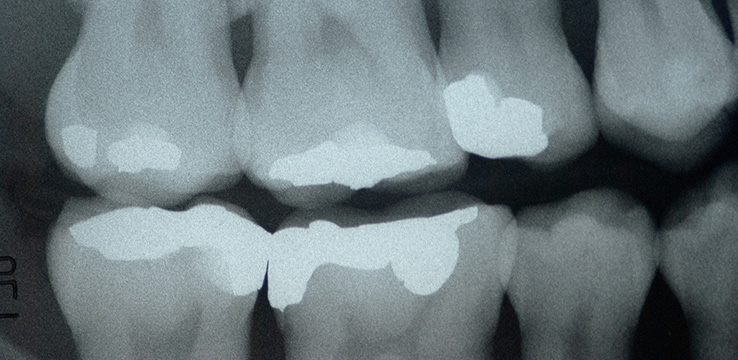
Cavities aren’t always able to be seen by the naked eye. Often, there is discoloration, sensitivity, or a visual deformity in a tooth that gives away the presence and location of a cavity, but the most common way your dentist can tell whether or not you have one is by viewing an x-ray, like the one shown above. Teeth are relatively radio-opaque, meaning they show up mostly white on an x-ray. A cary, as you can see, will show in an x-ray as a region of lesser radio-opacity. The dentist or hygienist who views your x-ray may probe around with one of their instruments to verify what they have seen. They will then speak with you about receiving a restoration, or filling.
A restoration procedure consists of three steps: drilling, prepping, and filling. Before beginning the procedure, the dentist will usually administer anesthetic. If the shot is administered to the very back of your mouth, it is called an alveolar block, or “block” for short. This will numb an entire quadrant of the gums, tongue, and lips, and is used when filling the molars or when more than one tooth is to be filled within the same quadrant. If the shot is administered anywhere else in the gums, it is called infiltration. This numbing will be more specific, but less effective, and so is used more toward the front of the mouth than toward the back. Once the anesthetic sets in, the restoration can begin.
First, your dentist (or, in rare cases, a heavily-licensed hygienist) will carefully drill the tooth that is in need of filling. The aim will be to maintain as much of the tooth’s original structure as possible while also ensuring that all of the decaying portion is fully removed. Next, either the dentist or an EFDA (expanded function dental assistant), who is certified to fill teeth, will prep the tooth to be filled. This includes disinfecting the tooth with a special tooth shampoo, rinsing, and lining the pit with an abrasive surface with adhesive. Finally, the actual “filling” can begin. There are two kinds of filling: Amalgam and composite. Amalgam is the “old school” approach to filling and was previously the predominant filling material. If you have a “silver” filling, you have amalgam. Composite is a white ceramic-like substance that is generally more popular because it can be produced in a number of different shades to match that of a tooth. Additionally, new composite materials are being produced which can rival the strength of amalgam. Both materials work well for filling a tooth, however, and your dentist may choose to use either depending on the circumstances. Once filled, a composite filling must be cured with a bright blue light. After some quick sanding of the new restoration for comfort, your filling is complete! For those who are curious, fillings are entirely radio-opaque, as shown in the picture below.
As a brief aside, the thought of receiving a filling terrifies some people, and there is nothing wrong with being afraid. Most modern offices offer nitrous oxide to their patients, often for free. This gas usually comes through a mask which is placed on the face and merely serves to take the edge off of this sort of anxiety. You should feel no shame in asking for this treatment, as I have even talked to some dentists and hygienists who prefer to use it, themselves, sometimes even for their regular cleanings. It is harmless and makes the experience less traumatizing for you. The dentist will also have an easier time working on a less tense patient. Restorations are a relatively easy and well-practiced procedure, but the concern for mistakes increases if the patient feels scared or uncomfortable.
Cavity Prevention for Dummies
In all, nobody wants to have a filling. The best way to make sure you don’t end up needing this procedure is simply to take care of your teeth. Brush twice daily to free your teeth of all that recycled refuse we call plaque, but also make sure you floss once a day. A very large portion of restorations are performed on the distal or mesial surfaces (see my previous post if you don’t know those words) because people fail to remove the plaque between their teeth. The easiest solution to this problem is to floss once daily. Otherwise, maintain regular appointments with your dentist so that if you do end up carrying a cary, you can carry out treatment as soon as possible. If left to expand to the pulp, a simple cavity could lead to a root canal, or even tooth removal. Often, by the time you are able to see or feel a cavity, it is already too late. Brushing and flossing prevent a majority of cavities, but not all cavities can be prevented. Allow your dentist to detect them early, lest you end up much worse off in the future.
 Dentistry 101
Leave a comment